Classics

Students have been studying Classics – the worlds of ancient Greece and Rome – at King Edward’s for almost 500 years. And we still believe the subject holds huge value for our students, culturally and intellectually.

There are four principal reasons why we think all Edwardians should encounter Classics, and the Latin language particularly:

  • It is intrinsically interesting. In their early terms, students will learn how an inflected language operates, and the ‘otherness’ of that code – with its satisfying patterns and structures – is in itself rewarding and intriguing. And that’s before we get to the myths, the monsters and the marching armies.
  • It is a literacy course. We would argue that doing Latin is the best way to get better at English, because Latin has a more transparent grammatical make-up and it trades in concepts like subordination and stem more transparently than English grammar – which can be confusingly haphazard, and partially understood. And the ‘otherness’ of Latin, and the ‘double otherness’ of Greek, helps us to distinguish the characteristics of our own language more clearly. In other words, because Greek and Latin are so alien, conceptually, we are forced to engage more thoughtfully with what exactly makes English, ‘English’.
  • It underpins modern languages. Latin gives you greater access – as a ‘meta-language’ – to its modern descendants in the Indo-European language family. This means the Romance languages (French, Spanish, Italian, Portuguese, Romanian) in the case of Latin. In the case of Classical Greek, which is offered from Upper Middles – this means Modern Greek and Russian, whose Cyrillic alphabet overlaps with Greek. 
  • It unlocks a cultural legacy. Latin and Greek are not spoken languages, they are ‘corpus languages’: we study them because they unlock texts which have shaped our world and continue to bear huge influence on the way our politicians communicate, the culture we consume on Netflix, and our notions of right and wrong. It is no surprise that the culture of ancient Greece, for example – which gave us the words drama, politics, history, climax, music, museum, comedy, mania, economy, idea, eureka, philosophy, metropolis, chorus, enigma and hippopotamus – is a rather interesting and important culture.

All boys study Latin for the first three years and Classical Greek is available as a language option in Year 9.

The boys who choose Greek (the ‘Hellenists’) prepare for a new, publicly examined qualification: the Intermediate Certificate in Greek, which has been designed as a one-year contained course leading to a qualification which has official recognition from universities and the Department for Education. This is a new undertaking for KES, even though Greek has been taught here since 1552, and it is an exciting chance for students to bank a great qualification within one year of study. This is ideal if students decide not to take up GCSE Classics, as they will still have something to show for their hard work. 

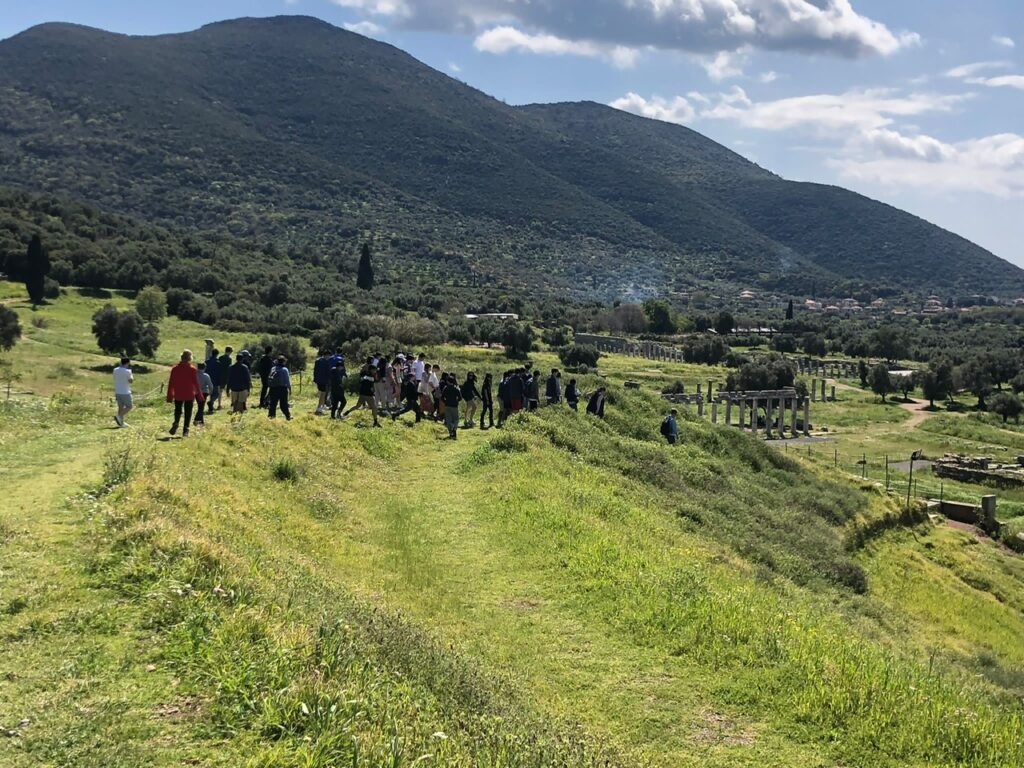
Students who have chosen to study Greek in Year 9 are given priority booking for the biannual Greek trip.

Students who choose to take Latin and Greek at GCSE can request to be exempted from taking a Modern Language at GCSE. This is an arrangement made on a case-by-case basis.

Two of the three papers sat at GCSE, in both Latin and Greek, are literature papers – one prose, one verse – and students can expect to enjoy unrestricted access to voices which first spoke thousands of years ago. 

Year 10 is largely language based, and those students who have thrived on navigating the hyper-structure of an inflected language will really enjoy reaching for mastery of Latin or Greek. At the end of Year 10, attention turns to the first set text and from that point the GCSE course becomes predominantly reading authors in the original: Virgil, Homer, Herodotus, Tacitus – the individuals who founded their genres. It is not for the faint-hearted, but as Johnson, Rowling or Zuckerberg will tell you – or Oscar Wilde, or Tom Hiddleston, or Karl Marx, or our very own Tolkien for that matter – anything actually worth doing is rarely a breeze.

Students who have chosen to study Latin or Greek at GCSE are given priority for the biannual Greek trip.

Discover the ancient world. Understand the modern one.

If you are reading this, you have probably studied Latin and/or Greek at GCSE. That alone tells us something about you: you are intellectually curious, hardworking and willing to embrace a challenge. You have chosen subjects that demand precision, imagination and independent thought, and you have discovered the extraordinary rewards of studying the ancient world. You have also probably faced the inevitable question: “Why are you studying Latin or Greek? Isn’t it a dead language?” If so, you will already appreciate that the answer is far more interesting than the question. Classics is anything but dead. The languages, literature, history and ideas of ancient Greece and Rome continue to shape our world, from politics and philosophy to art, architecture and literature. Studying them develops intellectual discipline, analytical precision and the ability to construct sophisticated, persuasive arguments. These are skills that universities and employers value highly, providing an excellent foundation for a wide range of future careers.

Is A-level Classics a big step up from GCSE? 

It is certainly an opportunity to deepen your knowledge and develop your skills, but it is also a natural progression from the foundations you have already established. You will encounter new challenges, explore more complex ideas and discover just how rewarding the subject can be.

A department that brings the ancient world to life

Our Classics department brings together a wealth of knowledge and expertise across the ancient world, from literature and linguistics to archaeology, politics and ancient history. We are passionate about our specialisms, but equally enthusiastic about exploring the connections between them. One of the most exciting aspects of studying Classics is the opportunity to examine the modern world through the lens of the past. We question ancient assumptions, debate enduring ethical and political dilemmas, and consider what Greek and Roman civilisation can teach us about our own. The intellectual revolution of fifth-century Athens, for example, continues to challenge and inspire us. The ancient world may be distant in time, but its legacy remains very much alive. Our joint-department approach with KEHS allows us to share expertise, teaching resources and events across both schools. In the sixth form, boys and girls study together, benefiting from a rich exchange of ideas and perspectives. This collaborative environment encourages lively discussion, thoughtful debate and a deeper understanding of the world around us.

A KES alumnus inspired by Classics: J. R. R. Tolkien

The influence of classical education extends far beyond the study of ancient texts. One of the most celebrated former pupils of King Edward’s School, J. R. R. Tolkien, author of The Hobbit and The Lord of the Rings, offers a compelling illustration of where a fascination with languages, mythology and the distant past can lead. After leaving KES, Tolkien went to Oxford, initially to study Classics at Exeter College, before changing his degree to English Language and Literature. His extraordinary literary imagination, fascination with languages and engagement with mythology helped him create some of the most enduring works of modern literature. Tolkien’s journey reminds us that the study of the ancient world is not simply about learning vocabulary, translating texts or understanding distant civilisations. It cultivates linguistic sensitivity, creative imagination, intellectual independence and an appreciation of how stories and ideas travel across centuries. At KES, we encourage our students to develop precisely this combination of scholarly rigour and imaginative curiosity. Whether their future lies in literature, academia, law, politics or another field entirely, the habits of mind fostered by Classics can open doors in unexpected directions.

Academic ambition and Oxbridge preparation

We are particularly proud of our sustained success in supporting students applying to Oxford and Cambridge to read Classics, alongside our strong record of examination results across the department. Small teaching groups allow us to give students individual attention and explore ideas in depth. Dedicated Classics teaching rooms and a departmental library provide an excellent environment for independent study and intellectual exploration. For students considering applications to Oxford or Cambridge, we offer focused preparation for admissions assessments and interviews, drawing on the knowledge and experience of our teachers. Our practice discussions encourage students to think critically, articulate their ideas clearly and respond confidently to unfamiliar questions.

Beyond the classroom

Classics at KES extends well beyond the classroom. Throughout the year, we organise opportunities for students to encounter the ancient world first-hand and engage with the wider academic community. Our previous trips have included visits to Greece, exploring major sites such as Athens, Delphi and Mycenae, and to Italy, with extended visits to Rome and Pompeii. Closer to home, visits to institutions, such as the British Museum, Chester, Oxford and Ashmolean, bring ancient artefacts and their stories vividly to life. Students are also encouraged to take part in a range of academic competitions, including classical language reading competitions, university and college essay competitions, and the Linguistics Olympiad. We are proud of our students’ achievements in these activities and the opportunities they provide to stretch their abilities beyond the examination syllabus. Each term, we host a lecture by a distinguished university scholar as part of Anagnostic Society, the oldest society in the school. These events introduce students and staff to current research, new interpretations and exciting developments in the study of the ancient world, fostering a genuine sense of participation in a wider scholarly community.

Be part of the Classics tradition at KES

We are proud to champion Classics in the West Midlands and to share our enthusiasm for the ancient world with the next generation of students. Whether you choose Latin, Greek or both, you will join a department that values intellectual curiosity, academic ambition and the pleasure of discovering something extraordinary in the literature, languages and history of the past. From the ideas that transformed ancient Athens to the literary imagination of our own distinguished alumnus Tolkien, the classical tradition continues to inspire new ways of thinking about language, culture and humanity. The ancient world still has much to teach us. At KES, you will have the opportunity to explore it, question it and discover how its ideas continue to shape our own. We look forward to welcoming you.

Future careers

Classics equips students with a unique set of skills. Classicists delve deep into intricate languages and soar above, exploring literature, history, philosophy, art and architecture. They’re adept at asking insightful questions about human civilisation, bridging the past with our modern world.

But how does this connect to the professional realm? The case for Classics, the oldest and broadest of the Humanities, is clear. Studying these subjects hones the invaluable skill of arguing effectively with limited evidence. This involves not only analysis and evaluation but also effective communication.

Learning Latin and Greek fosters a command of language – be it English, Spanish, French or the intricate case system of German. Classicists often transition into law, advertising, journalism, finance, and management consultancy. Many even venture into entrepreneurship, showcasing the creativity that thrives within this field.

Classics cultivates clever, adaptable, and interesting generalists who are always in demand.

Beyond the classroom

The Classics department runs two main societies at school: the Anagnostics, a classical play reading group and speaker programme running since 1952, and the Linguistics Club which prepares students for the annual UK Linguistics Olympiad. 

The department also runs biennial trips to Greece and Hadrian’s Wall, and recently has organised domestic trips to the British Museum; the Ashmolean in Oxford; and the Cambridge Greek Play. Classicists in the Upper School also have the opportunity to visit the Barber Institute of Fine Arts to view the world-famous coin collection. 

Meet the Head of Department

Mrs Ana Henderson

Mrs Henderson pursued her studies in Classics at Belgrade University in Serbia before moving to the UK to further her education at Manchester University, where she was awarded an MPhil in Greek Philology for her thesis on “Aspects of the Derivational Morphology, Semantics, and Onomasiology of Mycenaean Nomina Agentis and Instrumenti.” A dedicated educator, Mrs Henderson initially taught Latin and Classical Greek to university students before joining Nottingham High School for Boys in 2005.
 
Over the past two decades, Mrs Henderson has taught at several prestigious independent schools across the UK, including Cheltenham Ladies’ College and Rugby School. She joined King Edward’s School from Loughborough Grammar School, where she held the post of Head of Classics and Teaching and Learning Lead Practitioner.

An active member of The Association of Latin Teaching, Mrs Henderson regularly delivers CPD workshops to Classics teachers. Additionally, she is a Graydin educational coach, providing coaching training for staff. She is very passionate about empowering staff, pupils, and parents to improve their communication through coaching skills.

All Departments

Search our site